

Category: Analysis

  • Inside Blockmachine (SN19): Infrastructure, Incentives and Evidence of Demand

    Inside Blockmachine (SN19): Infrastructure, Incentives and Evidence of Demand

    Blockmachine offers a useful test of Bittensor’s commercial ambitions: can a subnet supply dependable infrastructure that developers would choose outside the token economy? Its product is blockchain RPC access, an essential service with established competitors and measurable operating costs. The interesting question is how customer demand, supplier performance and network rewards connect.

    This review examines public documentation and evidence available on 14 October 2026. Product descriptions and reported figures are attributed to their sources; documented mechanisms are distinguished from independently confirmed operation. No production benchmark, financial audit or customer interview was conducted.

    What Is Blockmachine?

    Blockmachine identifies itself as Bittensor Subnet 19. Its public repository describes RPC and archive-node infrastructure, while the validator guide specifies mainnet netuid 19. The Taostats SN19 listing provides an additional identity reference.

    The team page lists engineers Mark Davison, Jeff Horner, Ben Mason, Francisco Silva and Mahdi L’kotbi, developer-relations lead Doug Sillars, and strategic adviser Marcus Graichen. Proof of Talk identifies Graichen as Taostats’ founder and CEO. The code also sits in the taostat GitHub organisation. These connections establish a close relationship, without establishing the companies’ legal ownership structure.

    The Problem It Aims to Solve

    RPC, short for remote procedure call, lets an application ask a blockchain node for information or submit a transaction. A wallet may check a balance; an explorer may retrieve blocks repeatedly. Historical-state queries require archive infrastructure, which adds storage and operating complexity.

    Developers can run nodes themselves or outsource that work. Blockmachine’s proposition is to aggregate suppliers, route requests according to price and performance, and expose a familiar interface. This matters because cheaper access is useful only when answers remain accurate and capacity survives demand spikes. For terminology, see the Bittensor Glossary.

    How Its RPC Infrastructure Works

    The RPC documentation describes chain-specific JSON-RPC endpoints over HTTP and WebSocket, with account API keys shared across supported chains. Listed networks include Bittensor, Ethereum, BNB Chain, Base, Polygon, Optimism and Arbitrum. Endpoint documentation is evidence of an offered integration surface, rather than an independent uptime test.

    According to the technical overview, a protocol-operated gateway receives requests and selects eligible suppliers using price and quality. Miners operate the underlying nodes; validators audit their service. Latency, successful responses and reliability inform traffic allocation. A supplier’s attractive bid therefore does not guarantee that it receives requests.

    The method reference meters work in Request Units, or RU. Most methods cost one RU; specified methods and parameter ranges cost more. A request count and an RU total consequently measure different things. The schedule matters when comparing workloads or estimating bills.

    The whitepaper describes cryptographic verification for provable methods and reference-based checks for others. It also acknowledges that aggregate RU accounting is trusted to the gateway; sampled logs cannot fully reconstruct it. Independent suppliers do not make every component decentralised. The gateway remains an important operational and accounting dependency.

    Miners, Validators and Incentives

    The miner guide makes operators responsible for provisioning, synchronisation and storage. Suppliers register endpoints and submit dollar-denominated bids per unit of work. The validator guide describes auditors checking gateway logs against reference nodes, then submitting weights on-chain. Network settings are fetched from a registry, making the active configuration important.

    The whitepaper’s traffic-payment formula multiplies successful RU by the supplier’s bid. If the dollar value of available miner emissions cannot cover aggregate asks, payments are reduced proportionally. Settlement is in alpha, not guaranteed dollars. Dollar-denominated bids therefore do not remove a supplier’s exposure to token liquidity, prices or operating costs.

    There is a material qualification. The current miner README describes an additional base incentive: 90% of each chain’s base allocation is reserved for archive nodes and 10% for lite nodes. The archive portion goes to the five highest-traffic eligible archive nodes, proportionally to their traffic. That complicates the website’s traffic-only framing and creates an explicit concentration incentive.

    Documentation also gives different epoch lengths: 360 blocks in the whitepaper and 7,200 in the validator overview. This review does not claim either is the confirmed live setting. Neither the precise current base-incentive allocation nor a fully reconciled payout configuration was independently established.

    Product, Pricing and Competition

    On 14 October 2026, the public pricing page listed Standard at $9 per month for 5 million RU, Pro at $25 for 20 million RU, and Business at $125 for 100 million RU. Listed overages were respectively $5, $3 and $2 per million RU. These are advertised monthly rates, not verified customer invoices.

    The same page distinguishes keyless access, without archive access, from account plans. It says failed requests are not billed. Its “$1 per million requests” headline applies at scale and depends on method weights: a million expensive calls need not consume a million RU.

    Competition includes Alchemy, QuickNode and dRPC. Alchemy’s own documentation lists a pay-as-you-go rate of $0.525 per million compute units, alongside throughput and feature limits. Alchemy CU and Blockmachine RU are not interchangeable. A credible comparison must price the same methods, historical depth, response sizes, peak throughput and support requirements.

    Blockmachine’s savings calculator is vendor-produced, not an independent benchmark. Supplier competition may reduce costs, but customer procurement also depends on incident handling, contractual guarantees and predictable service. The relevant test is a representative workload under production conditions, including failures and bursts, rather than the cheapest headline rate.

    Usage, Revenue and Evidence of Adoption

    The clearest named deployment is Taostats, whose public footer credits Blockmachine. A Blockmachine case study dated 7 July 2026 claims 15 billion monthly requests and a reduction in Taostats’ monthly infrastructure spend from $6,700 to $2,500. Those figures are company-reported, not independently verified traffic or revenue measurements.

    Blockmachine also publishes testimonials attributed to Chain Insights and Bitcast. They describe service use, including an account top-up, but supply neither audited invoices nor a customer-count methodology. Named testimonials are leads for verification; they do not establish recurring external revenue or retention.

    The buyback dashboard reported five settled cycles and 6,613.37 alpha purchased, with an aggregate dollar value of approximately $16,300, when reviewed. Its latest listed cycle was 17 September 2026. The linked Taostats transaction record shows a successful batch containing an add-stake operation on netuid 19. That corroborates an on-chain action, not the dashboard’s entire financial account.

    The whitepaper proposes matching miner rewards with alpha purchases for a Protocol Stability Reserve, funded by customer payments. The dashboard attributes its buybacks to revenue. The transaction does not identify the original payments, prove that every reward was matched, or establish profit. Accordingly, this review treats the ledger as a useful transparency measure, not a revenue audit.

    Five separate measures are needed: RPC traffic demonstrates consumption; network rewards compensate participants; commercial revenue records customer payments; paying-customer counts measure commercial reach; profitability requires revenue minus relevant costs. None can safely substitute for another. No independently verified revenue total, paying-customer count or profitability statement was found in the reviewed sources.

    Protocol Fit: Does the Model Support the Product?

    Blockmachine links routing and reward calculations to a concrete task, which makes its incentive design assessable. Readers familiar with Beyond Market Fit: Understanding Protocol Fit in Bittensor will recognise the distinction between selling a useful service and rewarding the behaviour that makes it useful.

    The top-five archive allocation illustrates a tradeoff. Concentrating rewards may support dependable, high-capacity operators; it may also make entry harder for a new supplier awaiting traffic. The relevant evidence would include operator independence, traffic concentration, service quality and entry outcomes before and after the change.

    Bittensor’s emission documentation describes token issuance and participant distributions, rather than customer sales. The broader distinction is explained in Dynamic TAO Explained. Emissions may help finance capacity, but commercial sustainability still requires customers to value that capacity at prices that cover its costs.

    Limitations, Risks and Unanswered Questions

    The principal uncertainties concern gateway control, reference-node independence, verification coverage and supplier concentration. A documented penalty for incorrect answers is not itself proof that all errors are detected. Buyers need to understand which methods are verified, how reorganisation-related differences are handled, and what happens when reference infrastructure fails.

    The demand evidence is also incomplete. Taostats provides a relevant initial workload, but its close relationship with Blockmachine limits its usefulness as a test of unrelated customer acquisition. A traffic split between affiliated use, free access and paying external accounts would make the commercial picture clearer.

    Useful further disclosures would include recurring customer revenue, retention, concentration by customer and node operator, achieved service levels, and supplier costs. Publishing the active incentive configuration would resolve conflicting descriptions. As discussed in From Subnet to Supplier, product availability and business readiness require different evidence.

    Editorial Conclusion

    Blockmachine presents a specific infrastructure product, public technical material and a named deployment. Its strongest contribution to Bittensor is making a practical service and its incentives open to scrutiny. The evidence supports taking the product seriously; it does not yet support a conclusion about independently verified commercial scale or profitability.

    The next decisive evidence is measurable demand from unrelated paying customers, dependable service under independent testing, and reconciled economics. Until then, Blockmachine is a useful case study in how a subnet can approach a real infrastructure market—and how carefully a publication must distinguish an operating product from a proven business.
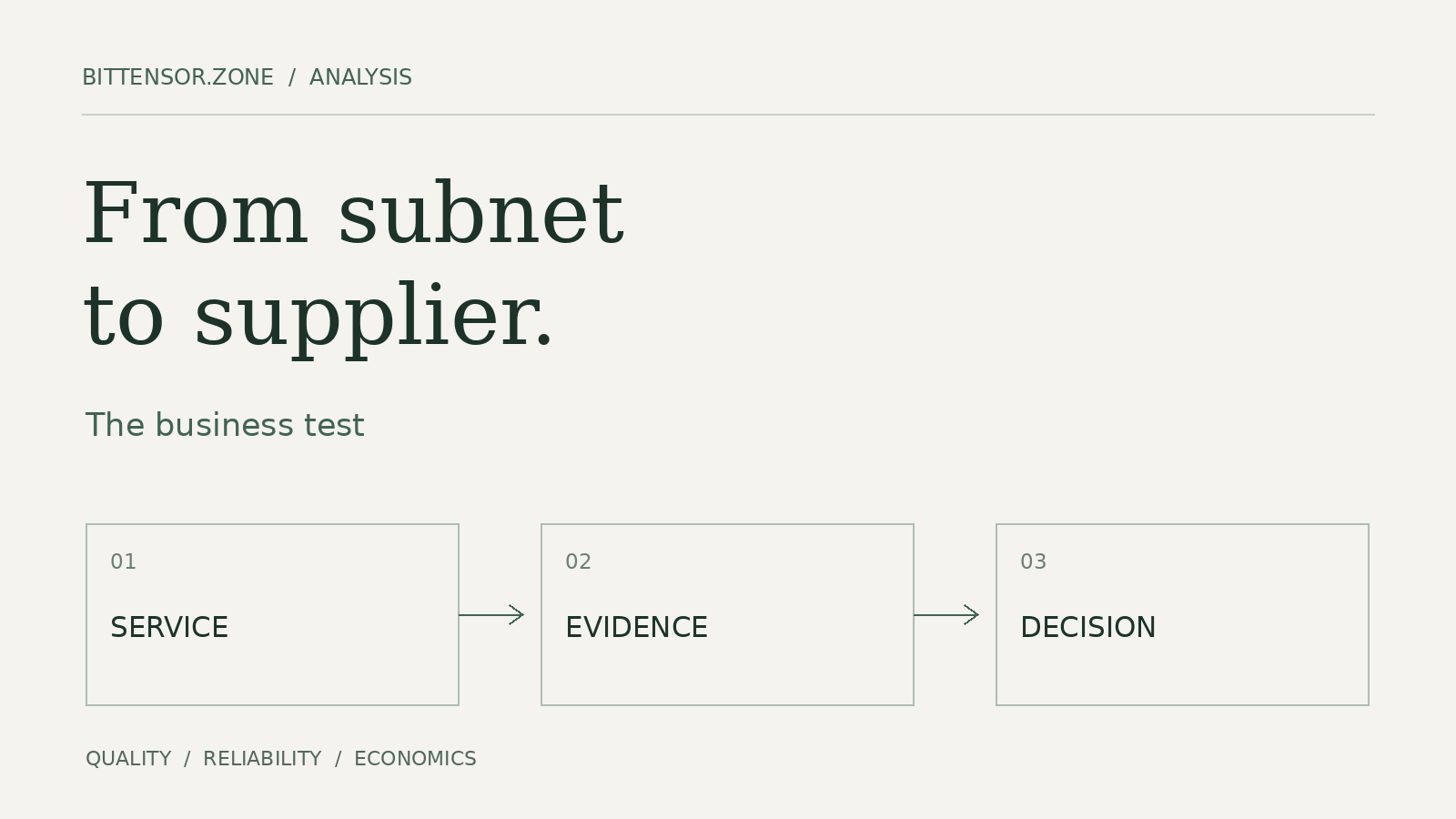
  • From Subnet to Supplier: Bittensor’s Business Test

    From Subnet to Supplier: Bittensor’s Business Test

    A practical guide to judging Bittensor-powered services: what customers can use today, what revenue disclosures show, and what would strengthen the case for protocol–market fit.

    Research cutoff: 10 October 2026.

    On 5 October, Lium published a guide to running an open-weight model on rented GPUs and connecting an application to a self-hosted API. The important development for a business reader is the workflow: a company can choose a model, rent capacity and expose a service without buying hardware. Lium’s guide, updated on 6 October, also makes the operating work visible—software versions, authentication, downloads and shutting down a test before it keeps billing. Lium’s deployment walkthrough is a product demonstration, not evidence of a customer deployment or measured business benefit.

    That is a useful starting point for evaluating Bittensor. The question is whether a service improves a real workflow enough for someone to adopt it, pay for it and keep using it. A working endpoint makes that question testable. A subnet’s existence alone does not answer it.

    Understand what you are buying

    Bittensor is a network that coordinates and rewards contributions to digital services. A subnet organises a particular task. Miners supply work or resources; validators evaluate contributions under the subnet’s rules. The protocol provides shared infrastructure and reward mechanisms. A customer-facing application, provider or API turns that activity into something a buyer can use. These are related layers, not interchangeable products. Bittensor’s incentive-mechanism guide explains the evaluation layer; our Bittensor introduction covers the basics.

    A company might buy model responses through Chutes, rent GPU capacity through Lium, or evaluate confidential virtual machines from Targon. It may never select an individual miner. The API or provider becomes its operational relationship: who takes payment, handles incidents and explains where data goes? Subnet identity helps trace the underlying system; it does not replace supplier due diligence.

    Customers do not necessarily need to understand Bittensor to benefit. Familiar interfaces can hide the network mechanics. Procurement still needs to establish whether billing requires a wallet, which entity provides the service, and whether changes underneath that interface could affect delivery.

    From protocol fit to protocol–market fit

    Our earlier protocol-fit analysis asks whether useful work can be defined, evaluated and rewarded. Here, protocol–market fit means something broader: can Bittensor’s shared incentives and infrastructure repeatedly support services that attract and retain external customers? This is an editorial hypothesis, not a formal protocol parameter or a claim that the network has already achieved it.

    Product–market fit belongs to an individual product: customers value it enough to return and pay. One successful provider strengthens the case that the architecture can support a business. It does not establish that the same mechanism works across different tasks, or that the protocol caused the success rather than the team’s software, sales effort or subsidies.

    Stronger evidence would combine repeat paid use across several services, credible delivery records and economics that remain workable as rewards change. Reusable integrations and cheaper access to complementary services could help that process repeat. The missing pieces are comparable customer cohorts, retention, revenue quality and costs—not simply more token activity. A protocol can finance useful supply before durable demand exists; the task is to establish the connection between them.

    What has changed—and what remains an announcement

    Recent product work is making evaluation more practical. Lium’s October walkthrough exposes the steps needed to operate rented compute. Its live marketplace lists hardware, locations and hourly rates. These give a buyer something to inspect and test. They do not show how reliably its own workload will run.

    Chutes offers a different route: hosted model inference through an OpenAI-compatible API. In a 15 September integration write-up, its team connected the Hermes agent’s configuration to Chutes—but the recorded completion attempt failed because the account lacked funds. An enclave evidence check passed structural checks without cryptographic verification. These qualifications matter: configuration, a successful response and verified security are separate milestones. The tooling may reduce setup effort; the post does not establish production reliability, savings or customer adoption.

    Gamma addresses a different part of the system. In its 28 September announcement, Bittensor described an upcoming release of usage credits acquired by burning a subnet’s alpha miner emissions. Alpha is a subnet-associated token; emissions are protocol rewards. Gamma was presented as a way to consume services built on the network.

    Status at the research cutoff: we could verify the announcement, but not a deployed Gamma payment flow or mainnet activation in the official material reviewed, including the Subtensor release index. This article therefore treats Gamma as an announced mechanism. It does not assume a standard redemption process, universal provider acceptance or a launch date.

    If implemented and accepted by providers, such credits could let builders direct reward-funded budgets towards compute or inference supplied elsewhere in the network. That could influence how services cooperate and how builders fund operating costs. These are expected possibilities, not observed outcomes. Spending funded by emissions remains different from spending by an external customer. A business evaluating a service today should verify its existing billing path rather than depend on Gamma’s future availability.

    Does activity translate into paying demand?

    Public dashboards provide useful evidence, but their definitions decide what that evidence means. On 10 October, Chutes’ team-operated dashboard displayed 20.43 billion model tokens per day as a seven-day average, and 1.75 million model requests for 9 October. Tokens here are pieces of model input or output, not cryptocurrency. These are service-volume measures. They do not identify unique paying customers, free traffic or retention; this snapshot alone establishes no growth rate. The dashboard’s combined Chutes/Squad user count is also broader than a count of business customers.

    For a dated revenue comparison, DefiLlama’s Chutes income statement, inspected on 10 October, listed $380.53 thousand for July 2026 and $388.11 thousand for August under gross protocol revenue. Pay-as-you-go revenue was $288.87 thousand and $289.10 thousand respectively. The displayed total increased modestly; pay-as-you-go revenue was nearly flat. September was marked with an asterisk and showed only $73.62 thousand. We could not establish complete September coverage, so it is excluded from the trend comparison. These are reported period totals, not annualized revenue.

    The open-source adapter retrieves Chutes’ own daily revenue API and sums subscriptions, pay-as-you-go usage, pending private instances and sponsored inference. The data is team-originated, even though another organisation displays it. The categories do not disclose customer independence, refunds or retention, and pending instances should not be confused with proven delivered usage. Fees and revenue are mapped to the same total: adding them would double count. The display also contains zero cost-of-revenue entries, which do not establish that supplying compute costs nothing or that the business is profitable.

    An older primary disclosure illustrates why volume alone is insufficient. In its 20 March business update, Chutes reported processing 45% fewer tokens over the preceding six weeks after removing free, abusive and uneconomic usage. It also reported a 37.7% improvement in revenue per million tokens since 1 February. These are the team’s historical figures, not measurements of the current quarter. They show why pruning activity can improve the quality of a business even while its headline throughput falls.

    At ecosystem level, SubConnect’s 2 October update reported an annualized subnet revenue estimate above $50 million, versus $32–35 million a month earlier. This is the publisher’s estimate, not an audited ecosystem account or revenue actually earned over a year. We could not verify a reconciled breakdown separating external demand, internal purchases, sponsorship and overlapping provider revenue. It is a research lead, not an aggregate this article adopts as established fact.

    Together, the sources support a narrower conclusion: there are accessible products, observable service activity and reported commercial receipts. They do not establish a uniform rise in external demand across Bittensor. Token trading, staking flows, market capitalisation and emissions answer other questions. None substitutes for customers returning and paying for a service.

    Three services, three different buying decisions

    Chutes — SN64: a business can evaluate hosted inference rather than manage a GPU server. Its quickstart documents access, and its pricing page lists input/output token rates and private deployment charges. API compatibility can lower migration effort; model behaviour, tool support, rate limits and failure handling still need testing. Chutes’ security documentation describes checks against modified software and substituted model weights. Those checks address integrity; they do not establish accuracy on a buyer’s tasks. Ask how miner rewards track capacity, valid work and service performance, and which failure modes are measured.

    Lium — SN51: GPU rental gives a team more control over its serving stack, alongside more responsibility for deployment, patching and monitoring. Marketplace location and reliability fields are useful screening information, not a contractual uptime promise. A cheap hourly rate may be outweighed by downloads, storage, idle capacity or engineering time. Ask what provider evaluation measures, how interruptions are handled and how an application recovers when a node disappears.

    Targon — SN4: its current product site offers virtual machines, bare metal and confidential compute. It describes Intel TDX isolation and attestation: evidence that a machine is running an expected configuration before a disk key is released. The site expressly limits confidential protection to supported virtual-machine hardware; bare metal is not confidential. That distinction is more useful to procurement than a broad “secure cloud” label. Request evidence for the exact deployment, supported hardware and trust boundary. Encryption does not establish deletion practices, legal protections or the correctness of an application.

    These are examples of different evaluation problems, not a ranking. We have not run paid workloads or independently certified their security and reliability. Our editorial subnet selection is a discovery starting point, not a supplier approval list.

    What evidence should a business request?

    Translate the network design into a short supplier checklist. Use the same questions for a conventional alternative; otherwise the pilot risks testing a narrative rather than a business improvement.

    Business questionEvidence worth requesting
    What workflow improves?A usable endpoint or product, current documentation and a baseline comparison.
    Do rewards favour useful work?Current scoring rules, integrity checks and tests of outputs on your tasks.
    Can we integrate and recover?Authentication, SDKs, rate limits, billing controls, versioning and fallback tests.
    Will quality hold under load?Task results, latency distribution, incident history, service commitments and support.
    Where does our data go?Deployment locations, access and retention rules, subprocessors and contractual terms.
    Is the total cost viable?Full pricing, integration effort, subsidy exposure and a continuity plan.
    Do customers keep using it?Verifiable deployments, repeat paid usage, retention and clearly defined revenue.

    Privacy needs its own review. Ask where requests, logs and backups go; who can access plaintext; which subprocessors participate; and when data is deleted. Chutes’ public data-processing agreement makes its subprocessor list available on request and allows international transfers. Obtain the current list and applicable terms before sending sensitive data. Decentralisation describes an operating arrangement; it does not automatically provide confidentiality or satisfy a buyer’s obligations.

    Commercial diligence should connect price to continuity. Ask which operating costs are supported by protocol rewards, whether prices could change if that support falls, and what happens to prepaid balances or reserved capacity. Subsidies can make a pilot attractive without proving a sustainable supplier business. Conversely, a subsidised service is not automatically unusable: the buyer needs a credible continuity plan and an acceptable exit cost.

    Run a pilot that can produce a decision

    Choose one bounded workflow: generating a first draft of support replies, serving a fixed model, or processing a repeatable batch job. Establish a baseline with the current supplier or internal setup. Keep the task, model where applicable, dataset and load comparable. Begin with synthetic or appropriately de-identified information until the data review is complete.

    Before the trial, write down success criteria: acceptable output quality, maximum tolerable errors, response-time requirements, completed-job cost and support expectations. Include integration and review labour in cost. Set a spending cap, a fixed evaluation period and a fallback route. These are proposed pilot controls, not benchmarks achieved by the projects discussed.

    Record unsuccessful calls as well as successes. Test bursts, quota exhaustion, interruptions and recovery; review billing against delivered work. For rented compute, include restart and checkpoint recovery. For confidential workloads, verify the evidence for the actual deployment rather than treating a feature badge as proof. Assess whether the team would choose to keep using the service after the introductory price or incentive ends.

    The evidence reviewed supports testing specific Bittensor-powered products against real alternatives. It does not yet establish protocol–market fit. That broader case becomes stronger when reliable services repeatedly win and retain external paying customers, with transparent economics and manageable dependence on rewards. A successful pilot answers the buyer’s question first. Comparable results across more products would help answer the protocol’s.

    Related reading: What is Bittensor? · Understanding protocol fit · Explore the editorial subnet selection.

    Sources and reading notes

    Primary documents and live pages were reviewed on 10 October 2026. Dashboard figures are snapshots; team claims are attributed above. This is editorial analysis, not a technical audit.

    Lium: October deployment walkthrough; GPU marketplace.
    Bittensor: understanding incentive mechanisms.
    Bittensor: Gamma announcement, 28 September; official runtime releases.
    Chutes: September integration test; API quickstart; pricing.
    Chutes: network activity dashboard; March business update.
    DefiLlama: Chutes revenue display; revenue adapter and definitions.
    SubConnect: October annualized revenue estimate.
    Targon: products and confidential-computing scope.
    Chutes: security architecture; data-processing agreement.
    TAOStats: Chutes; Lium; Targon.

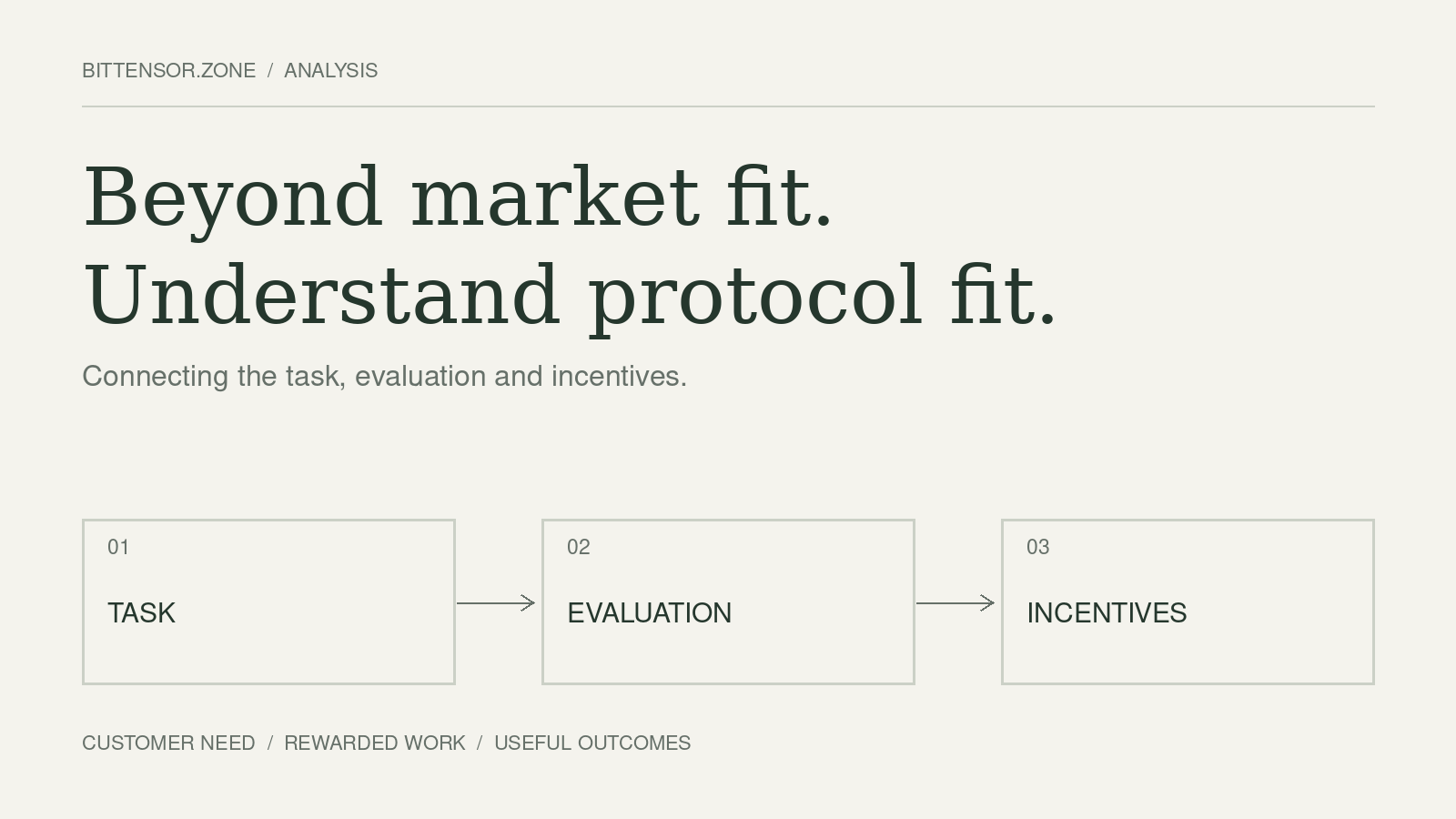
  • Beyond Market Fit: Understanding Protocol Fit in Bittensor

    Beyond Market Fit: Understanding Protocol Fit in Bittensor

    A customer problem is the starting point. In Bittensor, a second question matters: can a network of independently rewarded contributors produce the outcome that customers actually need?

    The work must fit the incentive mechanism

    Market fit asks whether people want a product and will pay for it. We use protocol fit as an editorial framework for a different question: whether useful work can be defined, evaluated and rewarded in a way that supports that product. It is not an official Bittensor consensus parameter.

    Bittensor subnets define mechanisms for evaluating miner contributions. Validators score that work, and those evaluations inform rewards. Miners therefore have a reason to improve the work that receives a higher score. The practical challenge is making that score reflect a useful service, rather than a convenient proxy. Source: Bittensor incentive-mechanism documentation ↗

    Five questions for a business use case

    Define the output. What does the customer receive: a model response, a dataset, a GPU instance or a vulnerability report? The deliverable should be specific enough to test.

    Test the evaluation. Does a higher score mean a better customer outcome? Useful checks may include accuracy, reproducibility, response time and resistance to manipulated results. The right tests depend on the service.

    Examine the incentives. What behaviour earns rewards? Consider whether participants benefit from sustained quality, or can succeed by optimising a benchmark without improving the product.

    Check delivery requirements. A network incentive does not replace an integration plan. Buyers still need suitable APIs, predictable availability, data-handling terms, support and a clear party responsible for delivery.

    Distinguish funding from demand. Protocol rewards can support production, but they do not by themselves establish paying customers. Evaluate external usage, customer retention and service economics separately.

    Cybersecurity: reward detection, then verify usefulness

    Bitsec offers a concrete example. Its published sandbox describes miner agents that analyse code and report vulnerabilities. Validators run and evaluate those agents against benchmark problems with known vulnerabilities. This makes detection performance an evaluable task. Source: Bitsec sandbox repository ↗

    For a security company, the potential benefit is access to detection capabilities improved through competition. That benefit depends on whether evaluation results carry over to its own code, whether findings are actionable and how sensitive repositories are handled. A benchmark score is not proof of complete coverage, continuous monitoring or fewer production incidents.

    A practical pilot would compare findings with an existing review process, reproduce reported issues and measure false positives and analyst time. This is a proposed evaluation approach, not a claim about an existing Bitsec customer deployment.

    Gamma: a proposed connection between emissions and service usage

    In its 28 September 2026 announcement, Bittensor described Gamma as usage credits obtained by burning a subnet’s alpha miner emissions. The announced purpose is to support consumption of services built on Bittensor. Source: official Bittensor announcement ↗

    TAO is the network’s native token; alpha is associated with an individual subnet. Gamma was presented as a usage-credit mechanism. These roles should be distinguished when discussing how a service is funded and how it is consumed.

    Status checked on 10 October 2026: the announcement describes an upcoming release. We have not verified mainnet activation, and the official release index reviewed does not list a Gamma activation. This article treats Gamma as an announced mechanism, not an available payment feature. Official release index ↗

    Our interpretation is that usage credits could make connections between subnet funding and service consumption more explicit. Whether they simplify procurement or collaboration will depend on implementation and provider acceptance. We do not assume universal redemption, cash refunds or guaranteed credit value.

    A hypothetical security service might need inference or compute supplied elsewhere in the ecosystem. Gamma could become relevant to such arrangements if supported by the implementation and providers. This is an illustration, not a confirmed integration. Internal spending would still need to be distinguished from demand by external customers.

    A useful starting point

    Choose a narrow customer task, identify how the subnet evaluates it and run a measurable pilot. A convincing business case connects the customer’s problem, the rewarded work and dependable delivery. Gamma may eventually affect how services are consumed; it does not remove the need to establish that connection.

    Explore our editorial subnet selection → · Read the Bittensor introduction →