A practical introduction to subnets, incentives and business relevance.
Bittensor is an open network that coordinates and rewards the production of digital services, including AI inference, computing and other specialised outputs. Its ecosystem is organised into subnets, each focused on a particular task.
To understand its potential, start with three questions: what work is being produced, how is it evaluated, and why are participants motivated to improve it?
How a subnet works
A subnet brings together participants around a defined task and a set of evaluation rules.
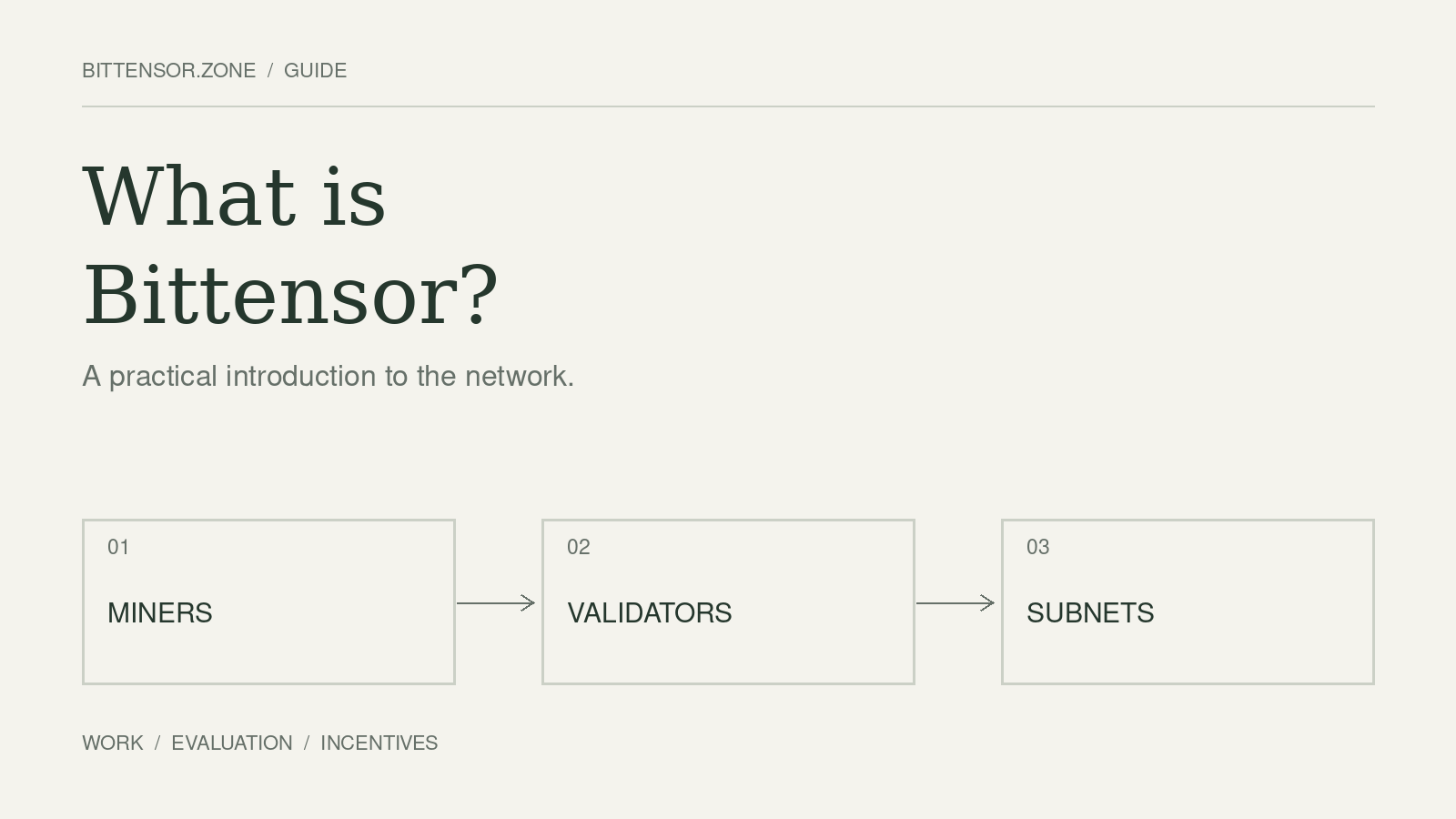
Miners produce the work. Depending on the subnet, they may operate models, provide computing resources or submit specialised agents. “Mining” here refers to contributing to the subnet’s task.
Validators evaluate performance. They assess miners’ contributions using the subnet’s scoring rules and submit scores to the blockchain.
Subnet owners design the mechanism. They define the work being requested and maintain the rules used to evaluate it.
Bittensor’s Yuma Consensus processes validator scores to help determine how rewards are distributed within the subnet.
Why incentives matter
Rewards give participants a reason to compete and improve their contributions. But the scoring system determines what “improvement” means.
If a subnet rewards accurate, useful results, participants have an incentive to produce them. If its evaluation can be manipulated, participants may earn rewards without delivering the intended benefit.
The important question is whether better scores correspond to better outcomes for users.
Where TAO fits
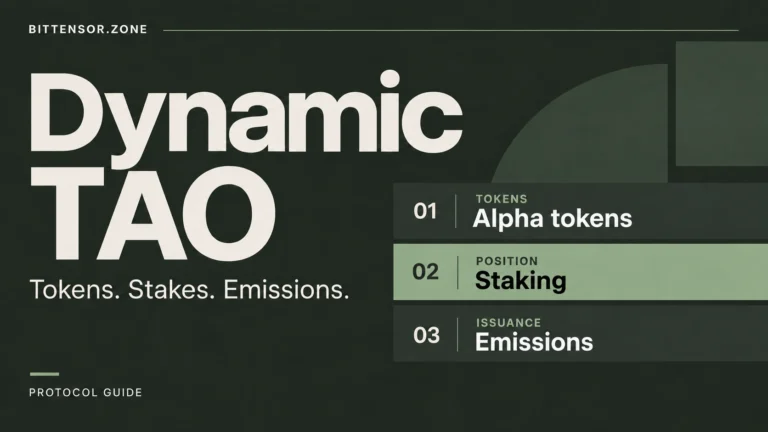
TAO is Bittensor’s native token. Subnets also have their own tokens, commonly called alpha.
Under Dynamic TAO, subnet participants receive rewards through subnet-specific token economics. This distinction matters: participating in a subnet does not simply mean receiving a fixed payment in TAO.
Token rewards encourage participation, but their existence alone does not demonstrate customer demand or commercial sustainability.
A practical example: cybersecurity
Bitsec documents a subnet model in which miners submit AI security agents that analyse code and report vulnerabilities. Validators run those agents in isolated environments and evaluate their findings against benchmark vulnerabilities.
A security company could potentially integrate such capabilities into recurring reviews of authorised codebases. Contributors would have an incentive to improve detection, while the company would still need to assess the reliability of findings, protect confidential code and manage remediation.
This is a concrete mechanism to evaluate—not a guarantee that every deployment will outperform existing tools.
For companies: understanding protocol fit
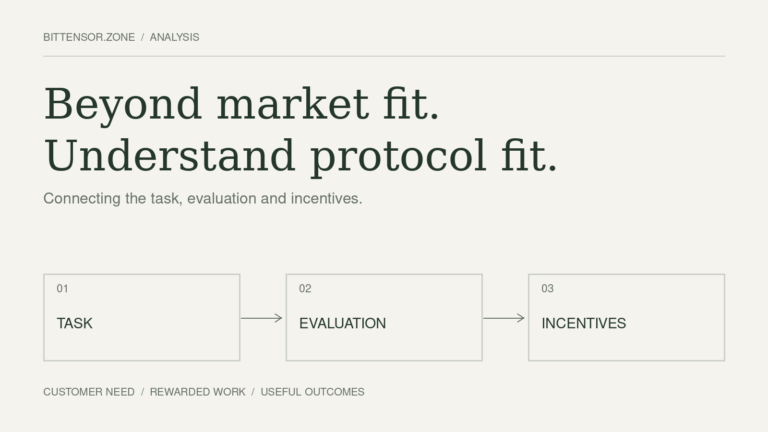
Product–market fit asks whether a product meets customer demand. We use protocol fit to ask whether the work behind that product suits Bittensor’s model of distributed contributions, evaluation and rewards.
A company exploring this approach should consider:
- Task clarity: Can contributors work on a clearly defined problem?
- Verification: Can useful results be distinguished from incorrect or manipulated outputs?
- Incentive alignment: Does earning a higher score help deliver what customers need?
- Operational fit: Can the service meet requirements for privacy, reliability and integration?
- Economics: Is there a credible business case beyond token-funded participation?
A strong use case needs both customer demand and a mechanism that rewards valuable work.
What to look at next
When exploring a subnet, examine its product, evaluation method and evidence of real usage alongside its token metrics.
The central question is whether its participants are producing something useful—and whether that usefulness survives outside the scoring system.