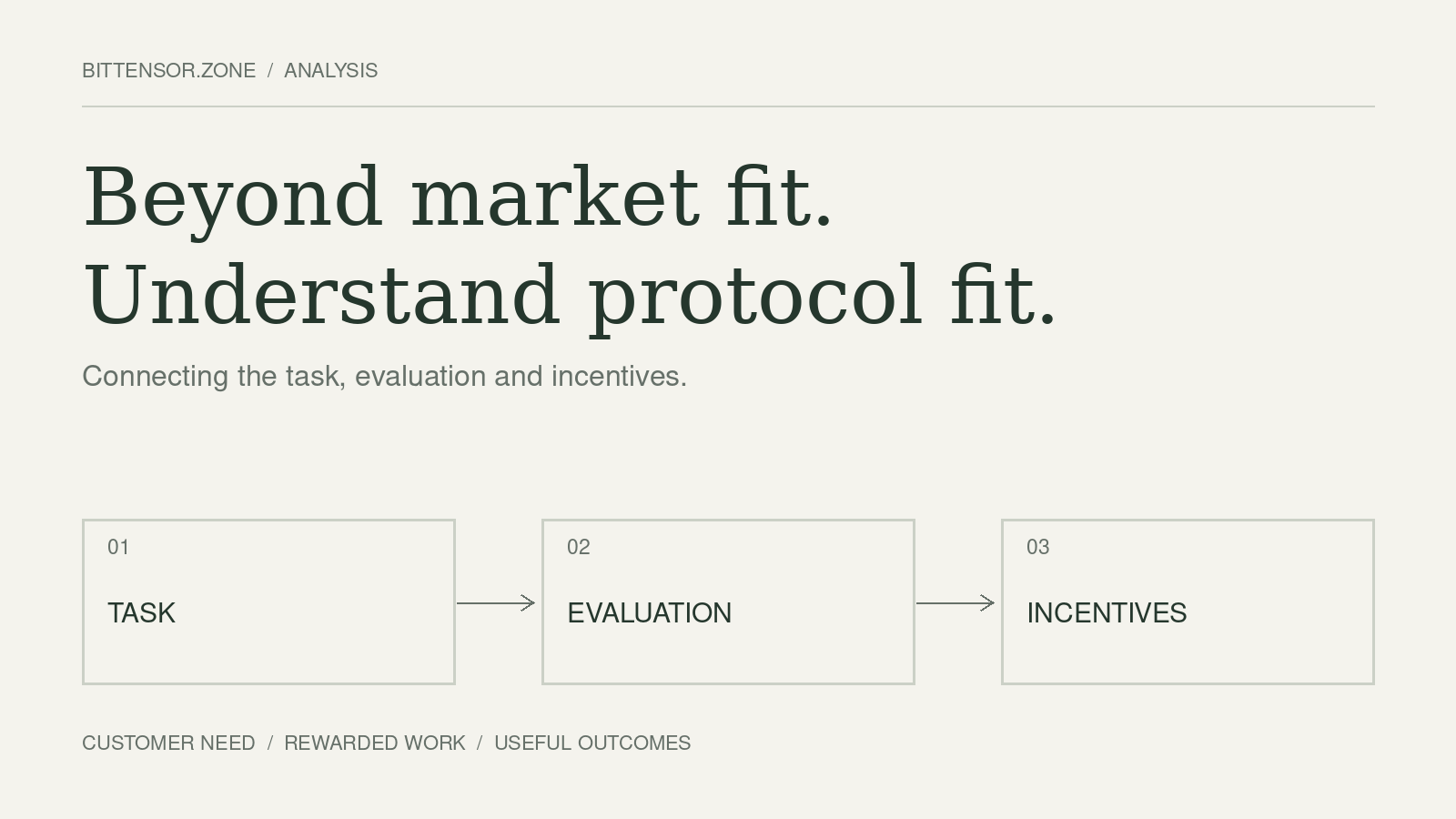
A customer problem is the starting point. In Bittensor, a second question matters: can a network of independently rewarded contributors produce the outcome that customers actually need?
The work must fit the incentive mechanism
Market fit asks whether people want a product and will pay for it. We use protocol fit as an editorial framework for a different question: whether useful work can be defined, evaluated and rewarded in a way that supports that product. It is not an official Bittensor consensus parameter.
Bittensor subnets define mechanisms for evaluating miner contributions. Validators score that work, and those evaluations inform rewards. Miners therefore have a reason to improve the work that receives a higher score. The practical challenge is making that score reflect a useful service, rather than a convenient proxy. Source: Bittensor incentive-mechanism documentation ↗
Five questions for a business use case
Define the output. What does the customer receive: a model response, a dataset, a GPU instance or a vulnerability report? The deliverable should be specific enough to test.
Test the evaluation. Does a higher score mean a better customer outcome? Useful checks may include accuracy, reproducibility, response time and resistance to manipulated results. The right tests depend on the service.
Examine the incentives. What behaviour earns rewards? Consider whether participants benefit from sustained quality, or can succeed by optimising a benchmark without improving the product.
Check delivery requirements. A network incentive does not replace an integration plan. Buyers still need suitable APIs, predictable availability, data-handling terms, support and a clear party responsible for delivery.
Distinguish funding from demand. Protocol rewards can support production, but they do not by themselves establish paying customers. Evaluate external usage, customer retention and service economics separately.
Cybersecurity: reward detection, then verify usefulness
Bitsec offers a concrete example. Its published sandbox describes miner agents that analyse code and report vulnerabilities. Validators run and evaluate those agents against benchmark problems with known vulnerabilities. This makes detection performance an evaluable task. Source: Bitsec sandbox repository ↗
For a security company, the potential benefit is access to detection capabilities improved through competition. That benefit depends on whether evaluation results carry over to its own code, whether findings are actionable and how sensitive repositories are handled. A benchmark score is not proof of complete coverage, continuous monitoring or fewer production incidents.
A practical pilot would compare findings with an existing review process, reproduce reported issues and measure false positives and analyst time. This is a proposed evaluation approach, not a claim about an existing Bitsec customer deployment.
Gamma: a proposed connection between emissions and service usage
In its 28 September 2026 announcement, Bittensor described Gamma as usage credits obtained by burning a subnet’s alpha miner emissions. The announced purpose is to support consumption of services built on Bittensor. Source: official Bittensor announcement ↗
TAO is the network’s native token; alpha is associated with an individual subnet. Gamma was presented as a usage-credit mechanism. These roles should be distinguished when discussing how a service is funded and how it is consumed.
Status checked on 10 October 2026: the announcement describes an upcoming release. We have not verified mainnet activation, and the official release index reviewed does not list a Gamma activation. This article treats Gamma as an announced mechanism, not an available payment feature. Official release index ↗
Our interpretation is that usage credits could make connections between subnet funding and service consumption more explicit. Whether they simplify procurement or collaboration will depend on implementation and provider acceptance. We do not assume universal redemption, cash refunds or guaranteed credit value.
A hypothetical security service might need inference or compute supplied elsewhere in the ecosystem. Gamma could become relevant to such arrangements if supported by the implementation and providers. This is an illustration, not a confirmed integration. Internal spending would still need to be distinguished from demand by external customers.
A useful starting point
Choose a narrow customer task, identify how the subnet evaluates it and run a measurable pilot. A convincing business case connects the customer’s problem, the rewarded work and dependable delivery. Gamma may eventually affect how services are consumed; it does not remove the need to establish that connection.
Explore our editorial subnet selection → · Read the Bittensor introduction →