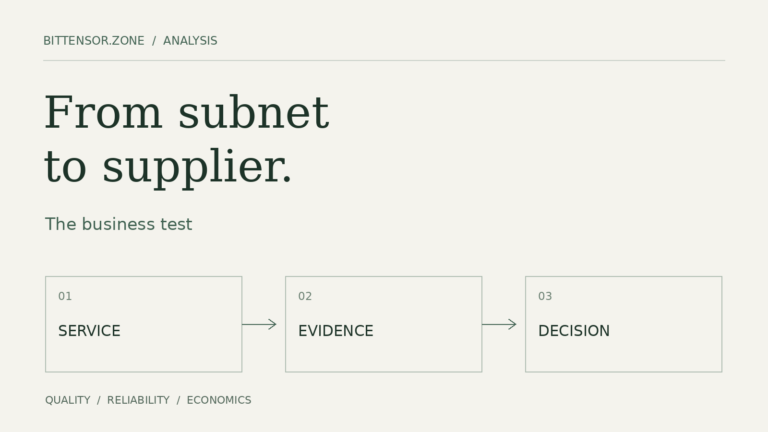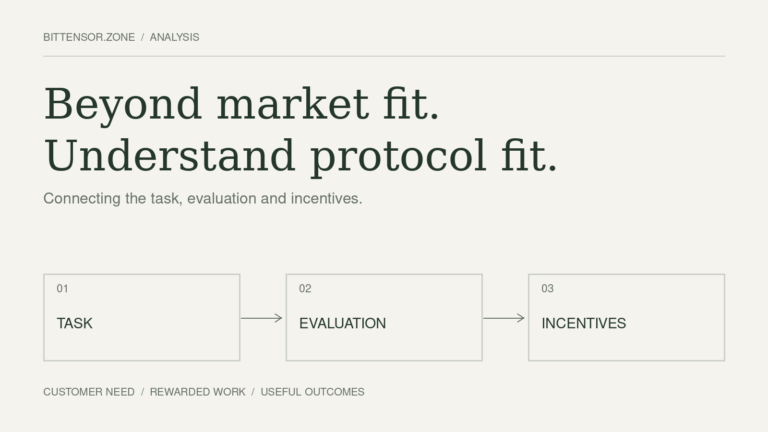

Blockmachine offers a useful test of Bittensor’s commercial ambitions: can a subnet supply dependable infrastructure that developers would choose outside the token economy? Its product is blockchain RPC access, an essential service with established competitors and measurable operating costs. The interesting question is how customer demand, supplier performance and network rewards connect.
This review examines public documentation and evidence available on 14 October 2026. Product descriptions and reported figures are attributed to their sources; documented mechanisms are distinguished from independently confirmed operation. No production benchmark, financial audit or customer interview was conducted.
What Is Blockmachine?
Blockmachine identifies itself as Bittensor Subnet 19. Its public repository describes RPC and archive-node infrastructure, while the validator guide specifies mainnet netuid 19. The Taostats SN19 listing provides an additional identity reference.
The team page lists engineers Mark Davison, Jeff Horner, Ben Mason, Francisco Silva and Mahdi L’kotbi, developer-relations lead Doug Sillars, and strategic adviser Marcus Graichen. Proof of Talk identifies Graichen as Taostats’ founder and CEO. The code also sits in the taostat GitHub organisation. These connections establish a close relationship, without establishing the companies’ legal ownership structure.
The Problem It Aims to Solve
RPC, short for remote procedure call, lets an application ask a blockchain node for information or submit a transaction. A wallet may check a balance; an explorer may retrieve blocks repeatedly. Historical-state queries require archive infrastructure, which adds storage and operating complexity.
Developers can run nodes themselves or outsource that work. Blockmachine’s proposition is to aggregate suppliers, route requests according to price and performance, and expose a familiar interface. This matters because cheaper access is useful only when answers remain accurate and capacity survives demand spikes. For terminology, see the Bittensor Glossary.
How Its RPC Infrastructure Works
The RPC documentation describes chain-specific JSON-RPC endpoints over HTTP and WebSocket, with account API keys shared across supported chains. Listed networks include Bittensor, Ethereum, BNB Chain, Base, Polygon, Optimism and Arbitrum. Endpoint documentation is evidence of an offered integration surface, rather than an independent uptime test.
According to the technical overview, a protocol-operated gateway receives requests and selects eligible suppliers using price and quality. Miners operate the underlying nodes; validators audit their service. Latency, successful responses and reliability inform traffic allocation. A supplier’s attractive bid therefore does not guarantee that it receives requests.
The method reference meters work in Request Units, or RU. Most methods cost one RU; specified methods and parameter ranges cost more. A request count and an RU total consequently measure different things. The schedule matters when comparing workloads or estimating bills.
The whitepaper describes cryptographic verification for provable methods and reference-based checks for others. It also acknowledges that aggregate RU accounting is trusted to the gateway; sampled logs cannot fully reconstruct it. Independent suppliers do not make every component decentralised. The gateway remains an important operational and accounting dependency.
Miners, Validators and Incentives
The miner guide makes operators responsible for provisioning, synchronisation and storage. Suppliers register endpoints and submit dollar-denominated bids per unit of work. The validator guide describes auditors checking gateway logs against reference nodes, then submitting weights on-chain. Network settings are fetched from a registry, making the active configuration important.
The whitepaper’s traffic-payment formula multiplies successful RU by the supplier’s bid. If the dollar value of available miner emissions cannot cover aggregate asks, payments are reduced proportionally. Settlement is in alpha, not guaranteed dollars. Dollar-denominated bids therefore do not remove a supplier’s exposure to token liquidity, prices or operating costs.
There is a material qualification. The current miner README describes an additional base incentive: 90% of each chain’s base allocation is reserved for archive nodes and 10% for lite nodes. The archive portion goes to the five highest-traffic eligible archive nodes, proportionally to their traffic. That complicates the website’s traffic-only framing and creates an explicit concentration incentive.
Documentation also gives different epoch lengths: 360 blocks in the whitepaper and 7,200 in the validator overview. This review does not claim either is the confirmed live setting. Neither the precise current base-incentive allocation nor a fully reconciled payout configuration was independently established.
Product, Pricing and Competition
On 14 October 2026, the public pricing page listed Standard at $9 per month for 5 million RU, Pro at $25 for 20 million RU, and Business at $125 for 100 million RU. Listed overages were respectively $5, $3 and $2 per million RU. These are advertised monthly rates, not verified customer invoices.
The same page distinguishes keyless access, without archive access, from account plans. It says failed requests are not billed. Its “$1 per million requests” headline applies at scale and depends on method weights: a million expensive calls need not consume a million RU.
Competition includes Alchemy, QuickNode and dRPC. Alchemy’s own documentation lists a pay-as-you-go rate of $0.525 per million compute units, alongside throughput and feature limits. Alchemy CU and Blockmachine RU are not interchangeable. A credible comparison must price the same methods, historical depth, response sizes, peak throughput and support requirements.
Blockmachine’s savings calculator is vendor-produced, not an independent benchmark. Supplier competition may reduce costs, but customer procurement also depends on incident handling, contractual guarantees and predictable service. The relevant test is a representative workload under production conditions, including failures and bursts, rather than the cheapest headline rate.
Usage, Revenue and Evidence of Adoption
The clearest named deployment is Taostats, whose public footer credits Blockmachine. A Blockmachine case study dated 7 July 2026 claims 15 billion monthly requests and a reduction in Taostats’ monthly infrastructure spend from $6,700 to $2,500. Those figures are company-reported, not independently verified traffic or revenue measurements.
Blockmachine also publishes testimonials attributed to Chain Insights and Bitcast. They describe service use, including an account top-up, but supply neither audited invoices nor a customer-count methodology. Named testimonials are leads for verification; they do not establish recurring external revenue or retention.
The buyback dashboard reported five settled cycles and 6,613.37 alpha purchased, with an aggregate dollar value of approximately $16,300, when reviewed. Its latest listed cycle was 17 September 2026. The linked Taostats transaction record shows a successful batch containing an add-stake operation on netuid 19. That corroborates an on-chain action, not the dashboard’s entire financial account.
The whitepaper proposes matching miner rewards with alpha purchases for a Protocol Stability Reserve, funded by customer payments. The dashboard attributes its buybacks to revenue. The transaction does not identify the original payments, prove that every reward was matched, or establish profit. Accordingly, this review treats the ledger as a useful transparency measure, not a revenue audit.
Five separate measures are needed: RPC traffic demonstrates consumption; network rewards compensate participants; commercial revenue records customer payments; paying-customer counts measure commercial reach; profitability requires revenue minus relevant costs. None can safely substitute for another. No independently verified revenue total, paying-customer count or profitability statement was found in the reviewed sources.
Protocol Fit: Does the Model Support the Product?
Blockmachine links routing and reward calculations to a concrete task, which makes its incentive design assessable. Readers familiar with Beyond Market Fit: Understanding Protocol Fit in Bittensor will recognise the distinction between selling a useful service and rewarding the behaviour that makes it useful.
The top-five archive allocation illustrates a tradeoff. Concentrating rewards may support dependable, high-capacity operators; it may also make entry harder for a new supplier awaiting traffic. The relevant evidence would include operator independence, traffic concentration, service quality and entry outcomes before and after the change.
Bittensor’s emission documentation describes token issuance and participant distributions, rather than customer sales. The broader distinction is explained in Dynamic TAO Explained. Emissions may help finance capacity, but commercial sustainability still requires customers to value that capacity at prices that cover its costs.
Limitations, Risks and Unanswered Questions
The principal uncertainties concern gateway control, reference-node independence, verification coverage and supplier concentration. A documented penalty for incorrect answers is not itself proof that all errors are detected. Buyers need to understand which methods are verified, how reorganisation-related differences are handled, and what happens when reference infrastructure fails.
The demand evidence is also incomplete. Taostats provides a relevant initial workload, but its close relationship with Blockmachine limits its usefulness as a test of unrelated customer acquisition. A traffic split between affiliated use, free access and paying external accounts would make the commercial picture clearer.
Useful further disclosures would include recurring customer revenue, retention, concentration by customer and node operator, achieved service levels, and supplier costs. Publishing the active incentive configuration would resolve conflicting descriptions. As discussed in From Subnet to Supplier, product availability and business readiness require different evidence.
Editorial Conclusion
Blockmachine presents a specific infrastructure product, public technical material and a named deployment. Its strongest contribution to Bittensor is making a practical service and its incentives open to scrutiny. The evidence supports taking the product seriously; it does not yet support a conclusion about independently verified commercial scale or profitability.
The next decisive evidence is measurable demand from unrelated paying customers, dependable service under independent testing, and reconciled economics. Until then, Blockmachine is a useful case study in how a subnet can approach a real infrastructure market—and how carefully a publication must distinguish an operating product from a proven business.