What does it take to build a business around a decentralized AI network?
For some companies, the answer begins with infrastructure, token holdings and rewards earned through participation. Others are trying to bring AI technology developed within the ecosystem to customers who may never have heard of Bittensor.
Both approaches are taking shape, and they reveal something important about the network’s economic development.
Consider a factory. It can operate around the clock, producing impressive machinery. But the orders coming in tell you whether people actually need what it makes.
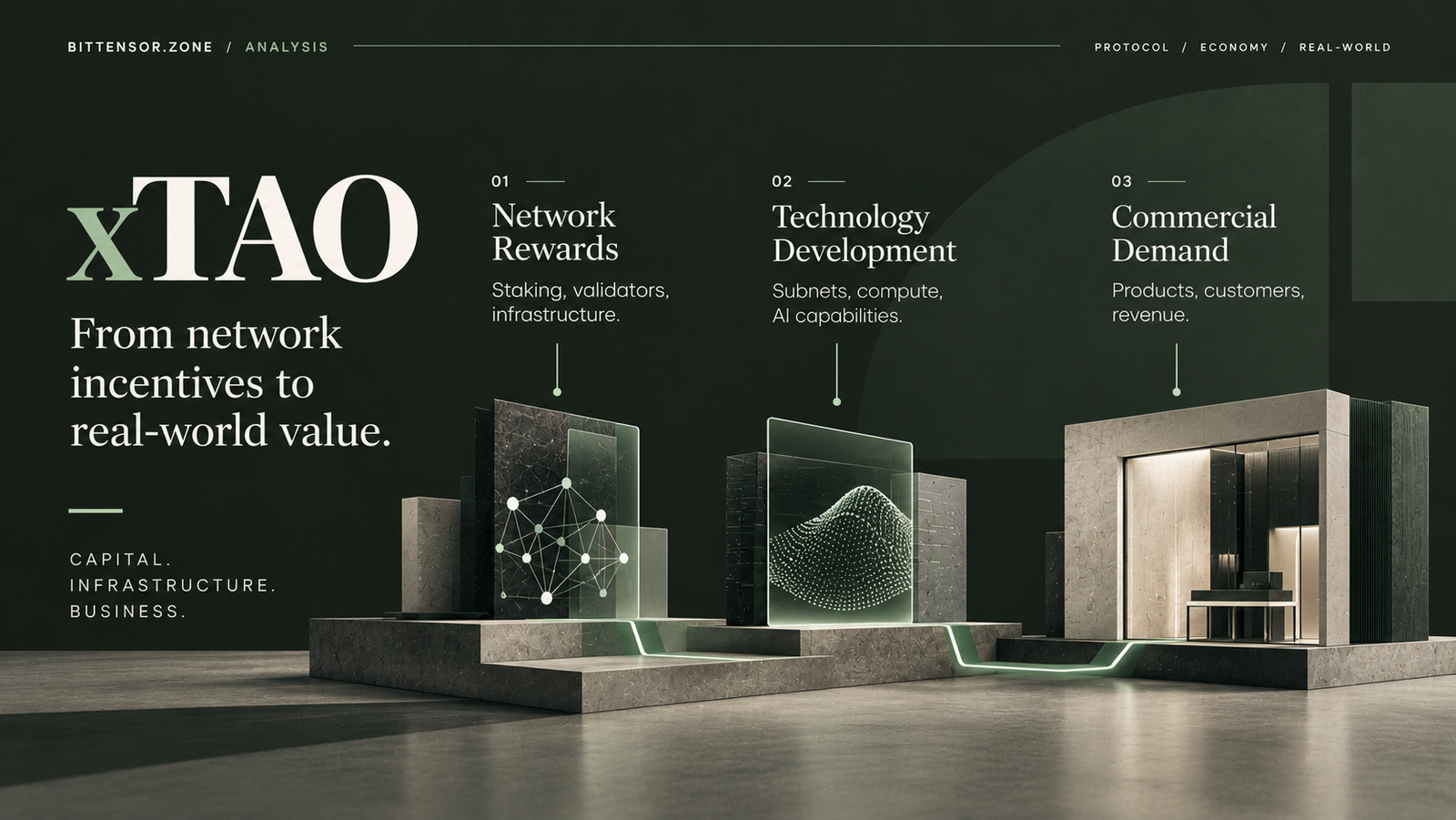
The factory represents Bittensor’s network, where miners and subnets are rewarded for producing AI-related work. The orders represent real customers willing to pay for what that work produces.
Both matter, but they tell us different things. Network rewards encourage development and participation. Paying customers demonstrate that the resulting technology has value beyond the network itself.
That distinction is central to understanding businesses like xTAO and TaoWeave.
Bittensor has built an incentive system for producing and evaluating AI-related work. The companies now forming around it offer a glimpse of how those incentives might support a wider commercial economy.
Two publicly traded businesses, xTAO and TaoWeave, provide useful examples. Their strategies differ, and the evidence behind each tells a different story.
xTAO: Earning Through Network Participation
xTAO is building a business around Bittensor infrastructure, validator operations and TAO holdings.
As of September 25, 2026, the company reported holding approximately 63,242 TAO. For the quarter ended June 30, it recorded $321,454 in staking revenue, reflecting rewards earned through participation in the network.
These are measurable financial results. They show that a company can generate reported revenue through Bittensor without first selling an AI product to an external customer.
There is an important distinction, however.
Staking rewards are received in digital assets and recorded at their dollar value. They are not the same as cash collected from customers. Their eventual economic value remains exposed to token prices, while operating infrastructure and maintaining a publicly traded company involve ongoing costs.
This makes xTAO’s business dependent, in part, on the performance and economics of the network itself.
Those economics are not fixed. Bittensor’s Root Reborn upgrade in August 2026 changed how root staking rewards accumulate, making earlier yield figures an unreliable forecast of future returns.
xTAO is also exploring a different source of revenue: providing API access and licensing arrangements that could make Bittensor-based services available to businesses and consumers.
That ambition matters. A company already operating within the network could eventually help customers use its technology without requiring them to understand wallets, validators or subnet tokens.
For now, xTAO’s documented revenue comes from network participation. Its broader commercial services remain a developing part of the business.
TaoWeave: Bringing Subnet Technology to Customers
TaoWeave is approaching the opportunity from another direction.
In May 2026, the publicly traded company invested $1 million in Manako Labs through a Simple Agreement for Future Equity (SAFE). It also secured rights to market and distribute Manako’s technology to enterprise customers in the United States and Canada.
Manako develops computer-vision technology associated with Score, Bittensor’s Subnet 44.
Rather than asking customers to participate in Bittensor, the business offers a service designed to solve problems they already face.
In October 2026, Manako announced that its Vision Agents were being deployed across an initial group of 124 unmanned Avia Xpress fuel stations in France.
Using existing cameras, the software identifies operational problems such as damaged equipment, payment-terminal failures and camera outages, then directs alerts to the appropriate staff.
For the station operator, the benefit is easy to understand. A problem that might otherwise go unnoticed can be detected sooner, without constantly monitoring every camera feed.
The customer does not need to know how a subnet works. The service needs to perform a useful job reliably.
The announcement provides evidence of a commercial deployment, but it does not answer every economic question.
Public disclosures do not establish the recurring revenue, profitability or independently measured operational performance of the French rollout.
There is also a distinction between the companies involved.
Manako operates the technology and announced the French deployment. TaoWeave’s commercialization agreement covers North America.
According to TaoWeave’s regulatory filings, its Manako distribution arrangement had generated no recognized customer revenue as of June 30, 2026.
The French deployment therefore offers evidence of progress for Manako’s product. It does not establish that TaoWeave’s North American distribution business has already succeeded.
What TaoWeave is building is a potential route between technology developed in the Bittensor ecosystem and customers in established industries.
Whether that route becomes a sustainable source of revenue will depend on customer adoption, successful deployments and repeat business.
Commercial Success and Network Value Are Different Questions
The two companies illustrate separate business models.
xTAO currently earns rewards through network participation while developing additional services. TaoWeave is investing in technology and commercial relationships that it hopes will generate customer revenue.
These are parallel opportunities, rather than stages every Bittensor company must follow.
They also raise a question that deserves closer examination: when a business pays for AI technology associated with Bittensor, how much of that value reaches the network?
A successful product may generate revenue for its developer, distributor or infrastructure provider. Whether it creates additional demand for a particular subnet or TAO depends on how the technology is delivered and how its economics are structured.
In Manako’s case, TaoWeave’s filings identify a dependency on Subnet 44. They do not establish precisely how each customer deployment interacts with the subnet or how much commercial revenue, if any, flows back to its participants.
This is not a reason to dismiss the commercial progress. It is a reason to distinguish the success of an individual company from the economic benefits captured by the underlying protocol.
A thriving ecosystem may eventually support both. The available evidence should tell us when that is happening.
What Would Meaningful Progress Look Like?
Public companies can bring capital, infrastructure, commercial relationships and reporting obligations into the Bittensor ecosystem.
Those contributions are valuable, but they are starting points.
For xTAO, progress would include demonstrating that infrastructure operations remain economically sustainable as network incentives evolve, alongside evidence that its planned commercial services can attract paying customers.
For TaoWeave, it would mean converting its commercialization rights into customer agreements, deployments and recurring revenue.
For Bittensor more broadly, the picture becomes stronger when successful products can demonstrate measurable customer benefits and a clear connection between their commercial activity and the network supporting them.
The emergence of companies like xTAO and TaoWeave suggests that Bittensor is attracting businesses with ambitions beyond holding its native token.
Some are already earning from participation. Others are exploring how subnet-linked AI can serve conventional industries.
The next chapter will be shaped by what customers use, what they continue paying for, and how much of that value ultimately supports the network.
That’s where the business story around Bittensor becomes especially worth following.