Bittensor is often described as a decentralized network for artificial intelligence. But knowing how a network works doesn’t tell us much about what people can actually do with it.
A more useful starting point is to look at the services being built around it.
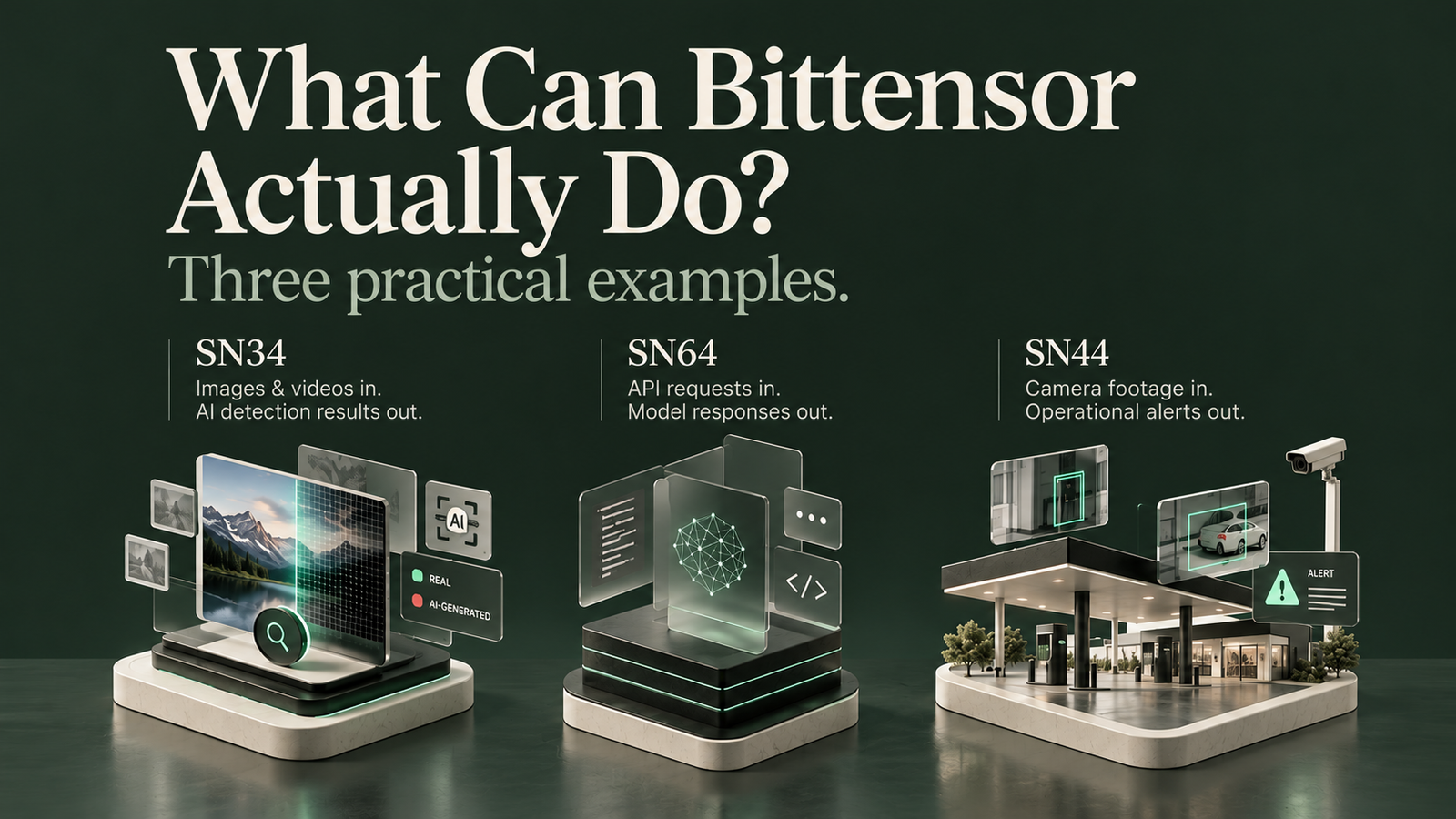
Today, you can try a tool that checks whether an image was AI-generated, access AI models through a developer API, or examine a system designed to identify problems using existing security cameras.
These are different applications, built for different users. Their connections to Bittensor also work in different ways.
How Does a Subnet Become a Service?
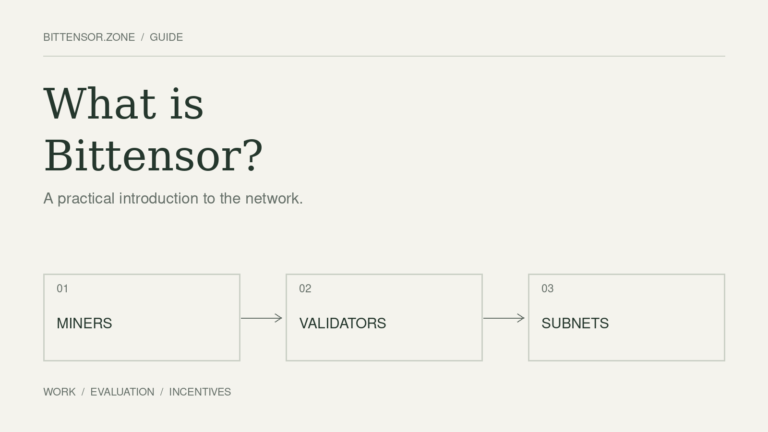
Bittensor organizes specialized work through networks called subnets. Each subnet defines what participants contribute and how that work is evaluated.
Some focus on developing better AI models. Others provide computing resources that applications can use.
A simple comparison is a workshop and a storefront. The workshop produces or evaluates work; the storefront delivers something customers can use. Some projects connect those activities closely, while others add substantial infrastructure between them.
The comparison isn’t exact, but it illustrates an important distinction: a Bittensor subnet and the product built around it are not necessarily the same thing.
Here are three examples.
1. BitMind: Checking Whether Media Was Generated by AI
Imagine seeing a convincing photograph online and wondering whether it was created using AI.
BitMind provides a tool that analyzes images and videos for signs of synthetic generation. It also offers a browser extension that can examine content while you browse.
For an ordinary user, this is one of the simpler ways to explore a Bittensor-related application. You can access the detector without first understanding staking, subnet tokens or validators.
The connection to Bittensor
BitMind develops technology associated with GAS, Bittensor Subnet 34.
GAS runs two related competitions.
One involves participants submitting models designed to distinguish authentic media from AI-generated content. Those models are evaluated using tests that assess detection performance and the reliability of their confidence estimates.
The other involves participants generating synthetic images and videos that challenge detection models. Their contributions are evaluated under separate rules.
The GAS repository documents these mechanisms.
Importantly, miners developing detection models are not simply processing every request sent to BitMind’s public detector.
BitMind describes a system in which submitted models are evaluated through the subnet, while selected models can be deployed through the company’s own infrastructure.
That separation allows the subnet to focus on model development and evaluation without exposing every customer request to participating miners.
What can we verify?
BitMind has a public detector and an installable browser extension. GAS also has publicly available code explaining its competition rules.
These establish that there is a product to explore and a documented technical process behind the subnet.
They do not prove that every detection result is accurate, or establish which specific models handle every customer-facing request.
A detector can incorrectly flag authentic content or miss synthetic material. Its results should therefore be considered an additional signal rather than definitive proof.
Try it: Visit the BitMind detector using a non-sensitive image, or explore its browser extension.
2. Chutes: Accessing AI Models Without Managing the Hardware
Suppose you’re developing an application that answers questions, summarizes documents or processes information using an AI model.
Running that model yourself may require specialized GPUs, server configuration and ongoing maintenance.
Chutes offers an alternative.
Developers can access available AI models through an API, which lets one application request work from another service.
Instead of managing the hardware, a developer sends a request to a model available through Chutes and receives a response that can be incorporated into an application.
The platform also supports deploying custom AI workloads.
The connection to Bittensor
Chutes operates through Bittensor Subnet 64.
Here, the subnet’s contribution is different from GAS.
Independent providers supply computing resources that help run AI workloads. The subnet’s incentive mechanism evaluates their contributions.
Chutes’ miner documentation describes rewards based on accounted compute time over a seven-day evaluation window, alongside additional incentives for certain deployments.
Providing hardware alone does not guarantee rewards. The resources must contribute work under the network’s rules.
The Chutes platform handles the customer-facing experience, including model access, authentication, deployment tools and billing.
Developers therefore interact with a service, while the underlying network coordinates computing contributions.
What can we verify?
Chutes provides a public model catalog, developer documentation, API instructions and pricing information.
Those resources allow developers to investigate the service and test supported models, subject to account requirements and applicable charges.
They do not establish that Chutes is automatically cheaper, faster or more reliable than competing infrastructure.
A developer considering it for production should test response quality, latency, availability and cost under realistic conditions. Data-handling requirements also matter, particularly when applications process sensitive information.
Public documentation supports the existence of the service and explains how to use it. It does not independently establish customer profitability or the commercial sustainability of every workload.
Explore it: Browse the Chutes model catalog and review the developer guide.
3. Manako and Score: Using Cameras to Identify Operational Problems
At an unmanned fuel station, a payment terminal can fail or equipment can become damaged without anyone noticing immediately.
Security cameras may record the problem, but recordings are not especially useful if nobody reviews them until later.
Manako develops computer-vision software intended to identify operational issues through existing cameras and send alerts to the people responsible.
The aim is to turn visual information into something staff can act on.
Unlike BitMind or Chutes, this is primarily a business-oriented service rather than a self-service application for individual users.
The connection to Bittensor
Manako identifies Score, Bittensor Subnet 44, as part of the technology supporting its computer-vision development.
Score’s public TurboVision repository describes a system in which miners contribute models for defined vision tasks.
Those contributions are evaluated, and validators use the results to calculate the weights associated with network rewards.
This provides a documented mechanism for developing and evaluating specialized computer-vision capabilities.
Manako separately builds the software used by commercial customers.
The company says its AVIA deployment processes video locally, at the stations, rather than transmitting raw footage to external servers.
The available documentation does not establish the complete technical path between models evaluated by Score and the software installed at each customer location.
What can we verify?
On 6 October 2026, Manako announced a rollout involving an initial group of 124 unmanned AVIA Xpress fuel stations in France.
TaoWeave, an investor in Manako, published a corresponding announcement on 7 October through a filing with the US Securities and Exchange Commission.
According to the companies, the system is intended to identify equipment failures, damaged infrastructure and camera problems, then direct alerts to the relevant staff.
The announcement is a concrete example of reported commercial deployment.
However, it does not independently establish the performance of all 124 locations, measured reductions in downtime or the precise contribution of Score to the deployed system.
Manako’s broader self-service offering is also not currently available in the same way as BitMind’s detector.
Explore it: Read Manako’s AVIA announcement and its earlier explanation of the Score relationship.
Why Use Bittensor for Any of This?
AI detectors, model-hosting platforms and computer-vision systems can all be built using conventional infrastructure.
Bittensor did not invent these types of applications.
Its contribution is a different way of organizing and rewarding the work behind them.
GAS encourages competition between detection models and synthetic-media generators. Chutes coordinates computing resources from independent providers. Score provides a framework for developing and evaluating specialized computer-vision models.
These approaches may help projects access a wider pool of contributors or improve the work being produced.
Whether they actually deliver better performance, lower costs or greater reliability than conventional alternatives depends on the project and the evidence available.
Those advantages cannot be assumed simply because a service uses decentralized infrastructure.
What Does It Mean When a Bittensor Project Is Working?
A product can exist without having proven all its commercial or technical claims.
BitMind provides a detector people can try, but the availability of that tool does not independently establish its accuracy in every situation.
Chutes exposes an API developers can use, but production reliability still needs to be tested.
Manako has announced a commercial deployment, but independently measured operating results are not publicly established by that announcement.
There is also an economic distinction.
Bittensor distributes rewards for work evaluated under subnet incentive mechanisms. Those rewards are not necessarily payments made by customers.
A subnet can reward technical contributions while the business built around them is still developing its market.
Understanding the difference matters when assessing the maturity of a project.
Do You Need TAO to Use These Services?
Not necessarily.
BitMind offers a conventional web interface. Chutes provides developer accounts and payment options. Manako’s products are offered through commercial arrangements.
A person using these services does not necessarily need to own TAO or participate in subnet staking.
Using a product and participating in the network’s economic system are separate activities.
For readers interested in staking and subnet tokens, our guide to Dynamic TAO explains that side of the network.
Where to Explore Next
These three examples show different ways technology connected to Bittensor can become useful: checking media, accessing AI models and analyzing activity in physical environments.
They are not representative of every subnet, and they have different levels of publicly available evidence.
If you’re new to Bittensor, an accessible product is a reasonable place to start. See what it does, what it costs and whether it solves a problem you recognize.
Then examine the subnet behind it. What contributions does it reward? How are they evaluated? And what evidence connects that work to the product?
You can explore more projects through the Bittensor.zone Subnets directory.
For a deeper examination of how technical performance relates to customer demand, read From Subnet to Supplier: Bittensor’s Business Test.
Sources and Research Notes
Research cutoff: 18 October 2026. Product capabilities, pricing and deployment status may change.
Bittensor
BitMind / GAS
- GAS — Subnet 34 Public Repository
- BitMind — GAS Architecture and Model Submission
- BitMind — Public Detector
Chutes
Manako / Score
- Score — TurboVision Repository
- Manako — Score and PwC Alliance
- Manako — AVIA Deployment Announcement
- TaoWeave — SEC Form 8-K, 7 October 2026
Bittensor.zone has not independently benchmarked these products, tested their production reliability or audited their commercial performance. Company-reported deployments are identified as such.